
Europe’s AI challenge is often described as a shortage of models, capital, or compute. Yet some of Europe’s most valuable AI inputs already exist inside hospitals, factories, energy systems, public administrations, and critical infrastructure.
They are simply not available to be gathered into one central training repository.
That is not a weakness. It is the operating reality of a continent whose highest-value data is tied to personal rights, industrial competitiveness, security obligations, public trust, and national resilience.
The next phase of European AI will be decided by the infrastructure that can work within that reality.
The data is already there
Europe’s industrial and public systems generate large volumes of operational data. Connected machinery, vehicles, robots, medical devices, energy assets, and other Internet of Things products produce raw and pre-processed data such as temperature, pressure, position, acceleration, speed, and flow-rate information.
The EU Data Act, applicable since 12 September 2025, was created in part to make industrial data more accessible and usable, clarify who may use it and under what conditions, and improve interoperability and competition in the cloud market.
This is consequential because the industrial data economy does not resemble the consumer-platform model. A manufacturer may not want to expose production telemetry, a utility cannot treat grid information as a freely exportable asset, and a hospital cannot approach patient records as ordinary training material.
Europe’s opportunity sits inside these constrained environments.
Health data proves the point
Health data is among the clearest examples. Under GDPR, health, genetic, and biometric data are special categories of personal data subject to additional conditions; their processing is generally prohibited unless a specific exception applies.
The European Health Data Space Regulation entered into force on 26 March 2025 and applies in stages beginning in 2027. It establishes a framework for cross-border use and exchange of electronic health data while giving individuals greater control and supporting approved reuse for research, innovation, policy, and regulatory purposes.
The regulation does not treat health data as a resource to be copied without constraints. Secondary use requires a permit from a health-data access body, takes place in secure processing environments, and prohibits personal-data downloads; pseudonymised data may be accessed only when anonymised data is insufficient.
That distinction matters. The objective is not unrestricted data movement. It is useful, accountable access under defined controls.
The European Commission estimates that the European Health Data Space could generate around €11 billion in savings over the next decade through improved access to and exchange of health data.
Critical systems carry different risks
Health is only one data estate. ENISA identifies digital infrastructure, energy, banking, transport, health, public administration, space, manufacturing, and research among the sectors covered by the EU’s NIS2 cybersecurity framework.
These systems generate data with high operational value. They also carry material security, continuity, commercial, and legal consequences when data is mishandled or exposed.
The logic is straightforward:
- A factory does not want to hand detailed production intelligence to an external competitor or uncontrolled environment.
- An energy operator cannot disregard the security implications of system-level operational information.
- A hospital must protect patient rights while still supporting legitimate clinical research.
- A public institution must retain governance over data linked to citizens and essential services.
A centralized data strategy often fails before model training begins because the parties holding the data have sound reasons not to release it.
Access is not the same as control
The Data Act improves access and portability, but it does not erase the need for safeguards. It preserves intellectual-property protections, allows measures to protect trade secrets, and permits restrictions where data sharing could undermine legally defined security requirements affecting health, safety, or security.
It also requires cloud and edge providers to remove obstacles to switching and multi-provider use. From 12 January 2027, providers of data-processing services may not impose switching charges; during the transition period, charges may not exceed direct switching costs.
This is an important shift. Europe is creating mechanisms for more data use and more cloud choice, while maintaining conditions around confidentiality, interoperability, security, and lawful control.
The architectural implication is clear: European AI infrastructure cannot assume that all valuable data will move to one cloud, one region, or one model owner.
It has to operate across many governed locations.
The architecture follows the data
This is where federated AI becomes strategically useful.
A federated approach can coordinate computation and learning processes across multiple sites while the underlying data remains under the authority of the organisation that holds it. The technical design does not remove the need for governance, privacy controls, cybersecurity, access permissions, or legal safeguards. It gives institutions a way to pursue shared intelligence without requiring raw data to become centrally pooled by default.
That is a better fit for Europe’s actual data landscape.
The European Commission is building the physical side of this equation. By May 2026, the EuroHPC Joint Undertaking had launched 19 AI Factories to give European start-ups and SMEs access to AI-focused supercomputing resources.
The Commission’s AI Continent Action Plan allocates €10 billion for AI Factories from 2021 to 2027 and states an objective of at least 13 operational facilities by 2026. InvestAI is intended to mobilize €20 billion for up to five larger AI Gigafactories.
Compute matters. But compute alone does not solve the challenge of learning from distributed, regulated, and commercially sensitive data.
Europe’s strategic advantage
Europe should not judge its AI position solely by the size of its consumer datasets or the concentration of its hyperscale platforms.
Its deeper advantage is the density of high-value data embedded in real economies: industrial systems, scientific institutions, healthcare networks, energy infrastructure, public services, and regulated enterprises.
The challenge is to make that data usable without demanding that those institutions surrender control over it.
This direction is already visible in European policy. The Commission’s technological sovereignty package, published in June 2026, links semiconductors, AI, cloud, open source, energy, and an EU-wide framework for assessing cloud and AI sovereignty.
The Data Act includes safeguards governing certain requests for access by third-country authorities to non-personal data held in the EU, while requiring interoperability and facilitating switching between data-processing providers.
Together, these measures support a European approach to AI built around governed participation rather than unrestricted extraction.
What Europe should build
Europe needs infrastructure that can coordinate work across AI Factories, enterprise environments, regulated institutions, and national systems.
It needs systems that can decide:
- Where a workload runs
- Which participants may contribute
- Which data remains local
- What outputs or model updates may move
- How access, permissions, auditability, and interoperability are governed
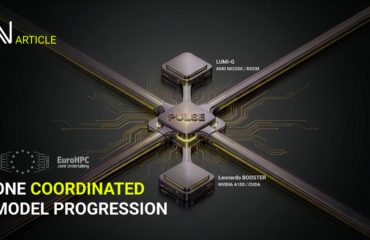
The same operating model is now being tested across LUMI-G and Leonardo BOOSTER: separate systems, separate stacks, and one coordinated model progression.
This is the layer SYNNQ Pulse is designed to address: orchestrating distributed AI workloads across heterogeneous infrastructure while enabling institutions to retain control over their data and operational environment.
Europe’s most valuable data may never sit inside one central repository.
That does not prevent European AI capability.
It defines the architecture required to build it.