

Europe is building an interconnected supercomputing network. Interconnection on paper is one thing. Getting independent systems to actually train, coordinate, validate, and improve AI together without collapsing into one centrally controlled environment is another.
That is the problem SYNNQ PULSE was built to address.
The European High Performance Computing Joint Undertaking (EuroHPC JU) has created access to world-class European compute capacity. LUMI in Finland and Leonardo in Italy represent two of Europe’s most capable systems, each with its own hardware, software environment, scheduling logic and operational context.
PULSE provides federated AI training and coordination across those differences.
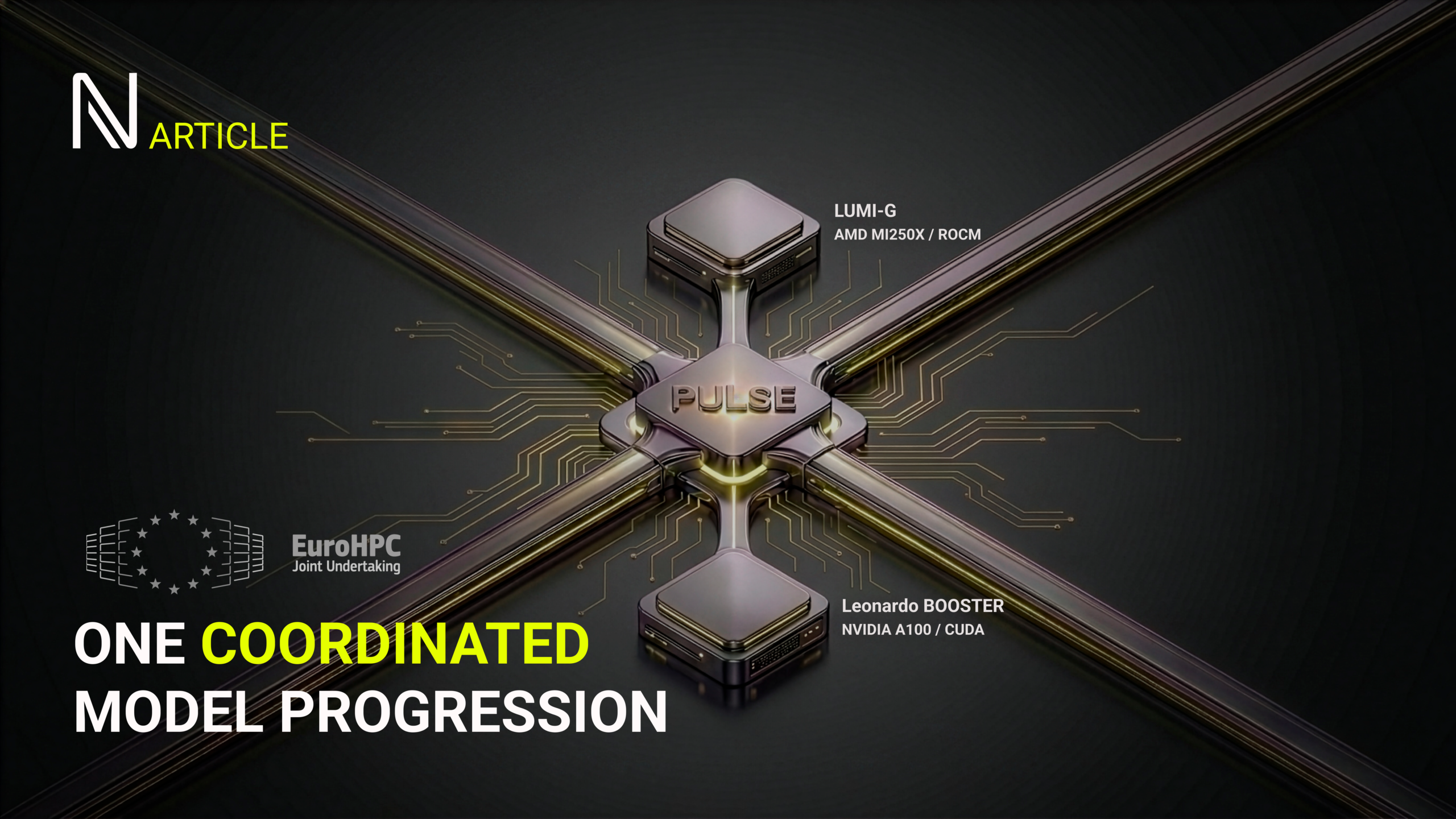
In a technical trial across LUMI-G and Leonardo BOOSTER, PULSE coordinated AI-training workflows across AMD and NVIDIA infrastructure, ROCm and CUDA environments, and separate schedulers.
The point was never to force those systems into a single cluster.
That would ignore the conditions European infrastructure must actually operate under: different operators, different hardware, different policies, different data domains and different local priorities.
The task is to make independent capacity work together without taking away the independence that gives it strategic value.
The operating model
PULSE treats every participating environment as its own execution domain. Each site retains control of local workloads, local infrastructure and local data. The system then coordinates what must be shared across the network: workload state, model versions, policy-aware participation, validated contributions and the progression of the model itself.
That creates a different model for European AI infrastructure.
Separate systems. Shared AI lifecycle.
LUMI can run its local workload on AMD MI250X hardware through ROCm. Leonardo can run its local workload on NVIDIA A100 hardware through CUDA. Each environment remains free to operate within its own scheduler and technical stack.
PULSE provides the coordination layer for federated AI training, allowing their contributions to become part of one controlled model progression.
Sovereignty remains local
European AI cannot depend on every participant using the same stack, giving up local control or moving sensitive data into one central location. That is not how Europe’s infrastructure is organised. It is not how its institutions, industries, research centres or member states operate.
The stronger operating model is federated by design. It enables federated AI training without requiring local sites to give up control of their infrastructure or data.
Data remains inside its originating domain. Local sites decide what they can contribute. PULSE validates contributions against the active model version and policy rules, then coordinates the next stage of the lifecycle.
This allows shared learning without requiring shared ownership of the underlying infrastructure.
Why adapters change the equation
Large-model collaboration across sites becomes unrealistic when every round requires moving entire model states across wide-area networks.
PULSE uses parameter-efficient adapter exchange for this kind of coordination. In the 32B LUMI-G–Leonardo BOOSTER benchmark, adapter-based coordination reduced cross-site synchronisation volume from 64 TB to 512 GB across 500 rounds.
The trial also indicated lower energy consumption during a LUMI training run, using roughly 30% less electricity than projected. This figure relates to the tested workload and run configuration; it is not presented as a universal reduction across all training workloads.
That changes the practical economics of cross-site AI.
The objective is not high-frequency, tightly coupled synchronisation between distant machines. It is controlled, periodic exchange of the model state that is actually needed for the next stage of learning. This is what makes heterogeneous European capacity usable as a network rather than a collection of isolated assets.
Beyond one trial
The LUMI-G–Leonardo BOOSTER federated AI training trial points towards a broader European operating model. AI Factories, national supercomputing centres, enterprise infrastructure, research organisations and sovereign cloud environments do not need to be converted into a single machine to produce shared capability.
They need a system that can coordinate them without flattening their differences.
EuroHPC’s AI Factory programme is expanding Europe’s AI-optimised supercomputing capacity. Leonardo sits at the centre of the Bologna AI Factory, while LUMI-G provides GPU capacity through Finland’s AI Factory environment.
- Different accelerators.
- Different schedulers.
- Different operating environments.
One coordinated model progression.
PULSE operates AI infrastructure as one sovereign system.